SCHOOL NEWS

The 2024-25 School Year Begins!
The brilliant goldenrod, abundant harvest, and foggy mornings highlight the beginning of our new school year. Sounds of laughter and learning fill the hallways and school grounds, as children settle into new classrooms and new rhythms.
Brilliant goldenrod, abundant harvests, and foggy mornings highlight the beginning of our new school year. Sounds of laughter and learning fill the hallways and school grounds as children settle into new classrooms and new rhythms.
In a beautiful first day of school Rose Ceremony, Orchard Valley’s new class of first graders was welcomed by their 8th grade buddies. The first grade students also heard a story from their class teacher, Victoria Mansuri, who shared the following reflection on the first week of school:
It was a wonderful first week in first grade! We learned that the whole world is made up of straight lines and curved lines. We found them in flowers, leaves, and many other places in nature; and in the classroom, in both toys and tools. We have practiced our forms with chalk on the big chalkboard and individual chalkboards, with paintbrushes and water on the chalkboards (which magically disappears!), walking them on the balance beam, and even drawing them with our toes! The forms come out of the story which began at the Rose Ceremony and is continuing daily.
The children are starting to learn the rhythm and form of the day. Upon arrival, after changing into their indoor shoes and shaking my hand, they may have some indoor play. When I ring the chime, it is time to clean up the toys and come to our seats. By Friday morning, after shaking a child's hand, I turned around and was surprised to find all the children at their seats, eager for Main Lesson to begin.
The transition from Kindergarten play to attentively listening and engaging in our (albeit playful) work is arduous. I have heard many pleas of, "I'm so tired." "When is snack?" "Is it dismissal yet?" The children are working so hard and need nourishment for body and soul to sustain their learning and growth. By the end of Lunch Recess, they are all ready for a soothing cup of tea and Rest and Reading. It is one of our cherished times of the day.
In the Maple Tree mixed age Kindergarten classroom, Joanna VonCulin shared insight into the deep social-emotional learning that takes place in an early childhood classroom:
Your children may well have been coming home quite tired - they are learning a lot, fast! They are learning how to care for one another, how to speak for themselves or seek help, how to share, and how to enjoy the company of their classmates. They are learning to check in with a friend if they've been hurt, and how to make age-appropriate amends, like fetching the 'care' basket or an ice pack. They are learning or fine-tuning fine motor skills with vegetable chopping, kneading dough, and coloring. Their gross motor skills are getting a wonderful workout outside, where the playground has uneven ground to traverse, trees to climb, and sand to dig in, to name a few attractions.
We've been doing a fairly short and sweet circle time, one designed to help new friends find their feet and learn the daily elements of circle. In it we have verses with movements for the children to imitate, songs that many already are learning, and a fun game "Sally Go Round The Sun." At this point, it is all about being able to come together as a class!
One of the circle songs really sums up what the first few weeks are about:
Kind hearts are the garden,
Kind thoughts are the roots.
Kind words are the flowers,
Kind deeds are the fruits.
Take care of your garden,
Plant many kind seeds,
And fill it with sunshine,
Kind words, and kind deeds.
A Visit from Michael Laughing Fox Charette
On a sunny Friday in January, the lower grades were thrilled to welcome Michael Laughing Fox Charette to campus. Michael Laughing Fox, a member of the third largest indigenous community in the United States, shared stories and music with grades 1-5 about the creation of the flute, a boy who thought he knew everything, Tailfeather woman, and the importance of animal relatives. Brought to us by Scrag Mountain Music and accompanied by Evan Premo on the Double Bass, the children were enthralled by stories and music, spreading the message that “stories show us there are more things connecting us than disconnecting us.”
On Friday, January 5th, Orchard Valley Waldorf School was delighted to welcome Michael Laughing Fox Charette to Grace Farm for a morning of indigenous storytelling and music with flute and drum.
Despite a chilly morning, the sun was streaming through the second grade classroom’s windows as the lower grades gathered for this special storytelling and musical experience brought to us free-of-charge by Scrag Mountain Music, thanks to a group of generous anonymous donors.

Adorned in orange and black with brightly colored embroidery and feathers in his headband, Michael Laughing Fox presented a message that “stories show us there are more things connecting us than disconnecting us.”
After introducing himself in his own language, and presenting the flag of the Red Cliff Band of the Lake Superior Ojibwe, Michael Laughing Fox first shared the story of the creation of the flute. Children were laughing at the story of the boy who thought he knew everything, and the “smart berries” that he got from his Grandmother. Little did he know that the berries were actually rabbit poop! From there, Michael Laughing Fox shared a flute song that was inspired by squirrels and the tale of Tailfeather woman, which showed that 2 warring nations can come together in peace. These messages have special importance in today’s world.

Bells jingling as he moved, Michael Laughing Fox showed the children how dance can be used to build spiritual energy, saying “Each step I take is like the heartbeat to mother earth.” Finally, the children were asked to participate in the performance during a rainstorm song, where the audience helped make the sounds of an approaching and waning rainstorm through snapping their fingers, slapping their legs, and stomping their feet.
After the performance, the children were able to look more closely at the flutes and drums, and ask questions. In total, 47 students and 6 adults were able to participate in the program thanks to the support of Scrag Mountain Music and donors. The 4th and 5th grade class wanted to share, “Their favorite story was the one about the "smart pills". They also liked the squirrel song and the story about the flute. We want to extend our heartfelt thanks and appreciation for his time.”
Kate Bennecker
OVWS Development Coordinator

New Sheep Arrive at Grace Farm
A new flock of sheep was recently welcomed at our Grace Farm campus in East Montpelier!
Over the past few years we have spent countless hours focused on our humble beginnings as a school. Searching and listening for our own unique truths and authenticity.
We are a school and community who deeply value outdoor, nature-based education. Our connection with one another extends well past the classroom walls and out onto the land. This includes extensive time and specials classes rooted in these values and also includes deep appreciation and care for this slice of heaven, aptly named Grace Farm.
During these years, we have patiently been asking what this beautiful property is asking of us. Today we took another step forward into this dream. It feels different than moving fence-lines and chicken coops. It feels like a step further into becoming who we were always meant to be…
Welcome to your new home Archie and crew!
~ Michelle Gullage, Grade 2 Teacher

An Exploration of the Twelve Senses
As it gets cold we are often invited into greater consciousness about what supports our sense of wellness. This sense of wellness is one of twelve senses described by Rudolf Steiner that we consciously endeavor to cultivate in our learning environment. Of these twelve senses we particularly work to develop four foundational senses in early childhood from birth to 7 years.
As it gets cold we are often invited into greater consciousness about what supports our sense of wellness? What do we need to feel well?
The sense of wellness is something we often take for granted because we usually feel it, we feel well. We learn to recognize the signs when our wellness sense is reminding us to slow down and soften, and we can see them in our children as well. Are they energized? or floppy? Is the color of their skin pale or different than usual? Is their gaze shining and ready to meet the day? Or are they looking for a place to curl up and hide away?
This sense of wellness is one of twelve senses described by Rudolf Steiner that we consciously endeavor to cultivate in our learning environment.
The first four foundational senses we seek to develop in early childhood from birth to 7 years.
Sense of Touch
The skin is the organ of the sense of touch and what is happening is that the children are learning to recognize the boundary of their body and to care for it. We nourish this with providing support for self initiated care and attention to dressing and undressing including attention to the fabrics and effectiveness of the clothes we recommend. In addition, we create a safe and welcoming space where exploration of touch is welcome and consciously cultivated with a wide array of sensory experiences in and outdoors with attention to the source of the things we provide in the environment preferring natural items grown from life itself, wood, wool, sand, grass, stone.
Sense of Life or Wellness
The autonomic nervous system is the organ of our sense of wellness and we support this sense by providing a routine that breathes, meaning that can adapt to the mood and energy of the group and the weather and the world. We also support the sense of life with effective clothing that supports a child in staying adequately warm for their safety and nourishment of their interest in engagement with teachers and students.
Sense of Balance
The inner ear is the organ of our sense of balance. The sense of balance is overall providing the child the freedom and time to explore up and down, sensing one's body in relation to gravity or the cosmos you could say. We can observe in the Morning Garden children as they become confident with walking the work they are taking up with the forces of gravity, work that only they can do. We provide them the time to really allow them to freely come to stand on their own, to run, gallop, wander and relish all the discoveries along the way.
Sense of Movement
The sense of proprioception or the sense of one's body and its parts in relationship to one another in space is becoming more and more well understood as foundational to neurological development. Even speech, which we don't think of as a form of movement, is really dependent upon the harmonious movement of many small muscles, bones, neurons and body chemistry that is influenced by the social and emotional environment. We live in times that more and more often confine children to limited physical positions and exploration. To support movement we provide a wide array of surfaces, we engage in play that explores movement. When we engage the children to move heartily, we strengthen their bodies, welcome flexibility, joy and imagination which will later be reflected in their thinking. Movement in gross and fine motor abilities, becomes confidence in landing on the earth.
The next four senses are often referred to as the middle senses. The foundational senses of touch, life, movement and balance are largely taking place within us. The middle senses are still very important to the young child, but they come into greater enjoyment in the Grades school aged child.
Sense of Smell
The sense of smell is the only sense that is fully formed at birth and guides the infant to the breast for the first time. The sense of smell can impact our children all the time, the scent of various cleaning products can be a kind of sensory clutter. We tend the sense of smell in early childhood by removing unneeded scents from our home so that our child can explore undisturbed. Some scents can be supportive: Often our classrooms use aromatherapy oils like lavender in a bowl of warm water to wipe down and freshen the environment. The smell of freshly cooked food fills the rooms, awakening the child's interest in food and surrounding them with natural scents of life. As our children grow older they express the qualities of their soul in their favorite smells.
Sense of Taste
The sense of taste is another great doorway to the world. We provide an array of foods that reflect different tastes and textures, everything offered but never required. Seasonal and festival foods draw our children toward the intimate experience of bringing the world into one's body as we eat. Preparing food together in a spirited kitchen. Picking berries and making jam or freezing them on trays for the winter. These are wonderful ways that food brings our children into a greater relationship with the world around them, subtly anticipates the changes in seasons, and affirms for them that the world is good. They need to know that in their bodies and bones.
Sense of Sight
The sense of sight is something we take for granted so often. We can observe for ourselves how the visual environment can heighten our spirits, encourage us and also go to sleep as the leaves fall and the colors of life become more subtle. Beauty is very important in the Waldorf classroom because sight immediately projects the things around us onto our inner life. What images do we want to fill the inner life of our children? I encourage you to consider this question for your family.
Sense of Warmth
The sense of warmth is the last of the middle senses and it provides a bridge to the spiritual senses. The sense of warmth has two meanings. We cannot sense warmth and express warmth if we are not well acquainted with the experience of being warm. This has a physical part to it that we attend to with great care, dressing our children well, feeding them warm foods, and preparing them to face and embrace the elements. And it also has a social part. When we are physically cold, it is uncommon to feel motivated to engage with others in loving ways. Yet when we are warm, our physical needs met, we can begin to feel curious and interested in the discovery of others and the world. We warm the social environment by anticipating and preparing for the physical needs of the children thoroughly and well. Then, our children shine their inner sun's that have been nourished by loving care toward new friends and the world around them.
The middle senses begin to express the qualities of our soul. As children grow to have a favorite color, a favorite fruit or food, a best friend. These are all the ways that their sensory development becomes a foundation for social wellness which is an essential foundation for learning overall.
The final four senses are sometimes referred to as the spiritual senses. For instance, the quickening that we feel within us as we behold a tree in full bloom is for me a kind of uplifting aha that brings me beyond the knowledge of the trunk, the function of the leaves, the smell of the blossoms and even the taste of the fruit. There is a glimpse of something whole, something in communion with others around it, the birds, bees, the cosmic forces. We behold it.
Sense of Hearing
The sense of hearing is not simply the auditory function of the inner ear, but the capacity to make sense of what is grasped through the ear. We can hear another person utter words, but how often do we completely misunderstand what is spoken? How wondrous and magical when we are understood.
Sense of thought
Thought sense is an extension of this, the ability to share a thought with another, to understand a thought and to coexist together in thought. We recognize when someone shares an understanding with us, there is a capacity to know and be known and we all know the feeling that arises when we are known.
Word Sense
is to be able to hear what is meant by words shared, which is not the same thing as understanding the meaning of vocabulary although the development of language is a foundation for this sense. How often were we able to convey something to someone when we don't have the exact words but we are interested enough in another to endeavor to be understood with word, gesture, facial expression. And they are interested enough to grasp what we have shared. This is the word sense, not simply to understand the meaning of words, but to integrate all of what is offered by another and to know what they mean.
"I" sense
is the culmination in some ways of all sensory activity. Our I sense is really our "I am" sense which is the foundation of the I-Thou relationship. Beyond each one of us is the higher self we strive to become. When we are able to make a home in ourselves for our higher self, we are endowed with gifts of love for others. Children from their earliest moments may recognize and embody glimpses of this spirited self. Often the three year old receives their first glimpse of this. While three year olds can sometimes be characterized as defiant, there is a way of beholding their acts of independence as already knowing something about their future self. What if we cared for our children with the understanding that they already know what they have to bring to the world?
The spiritual senses arise inwardly as an integrated awareness, a gradually developing awareness of others around us. Our sense of who we are and how we contribute to the whole. Every human beings needs to feel competent, capable and able to contribute. These are the spiritual senses unseen but not without signs.

My personal dragon’s name is Fear.
I didn’t realize how grounding it was to look my teacher in the eye every morning and be met with a firm and kind handshake and a welcoming “good morning.”
The day was filled with a focused main lesson, artwork, singing, and purposeful movement, which left me feeling alive. I did not realize my curiosity about the public school and my strong desire to leave the Waldorf school would cast me out on my own, leaving me to face my personal dragon, Fear.
OVWS alum Ida Eames reflects on the festival of Michaelmas and what it means to conquer our own personal dragons.
I was standing atop a grassy hill, sword in hand, ready. I was Saint Michael.
I was ready for this moment to be over. Not because I don’t enjoy acting, because I do, I love it. I wanted the moment to be over, so I could leave. I wanted to leave this Waldorf school that sheltered and protected me.
We celebrated Michaelmas every fall and now, finally, it was my last time ever taking part in the pageant. Just days prior, I had been begging my mom to let me go to a public school, but there I was, chosen to be Saint Michael, out of every other eighth-grader.
I was chosen to march down the hill to tame the dragon. The dragon was destroying the crops, the sustenance of the villagers, and the villagers were looking to me to save them.
At that moment with the warm autumn sun shining into my face, sword aimed at the dragon, I did not realize that there was so much more I had to learn about myself.
Michaelmas is celebrated at the time of the harvest between the summer and Winter solstices. The Archangel Michael, a powerful figure in Christian, Judaic and Islamic traditions, comes down from the heavens to tame the dragon that is wreaking havoc on the village. We all have the possibility within ourselves for personal transformation, and our own dragons to tame, whether greed, fear, selfishness, or other destructive forces. At Michaelmas, we seek to face with courage, one’s dragons to transform oneself.
My personal dragon’s name is Fear.
Fear was subdued at my old school. I did not know this dragon lived inside of me and was ready to break loose until I left the comfortable environment that nurtured me in my early years.
I didn’t realize how grounding it was to look my teacher in the eye every morning and be met with a firm and kind handshake and a welcoming “good morning.”
The day was filled with a focused main lesson, artwork, singing, and purposeful movement, which left me feeling alive. I did not realize my curiosity about the public school and my strong desire to leave the Waldorf school would cast me out on my own, leaving me to face my personal dragon, Fear.
I met Fear up close on the first day of my freshman year. There were computers, teachers, loud bells, and complicated rules, all new and startling to me. I felt so alone and uncared for, I felt fear deep in the pit of my stomach. Fear stopped me from going to school, trying new things, and eating. I became a person I did not recognize, scared, and unconfident. Where was my sword to tame this dragon?
I discovered my sword. It was there, inside me, a burning light, dimed in those harsh moments of change. I was still there, the enthusiastic and determined child who was the first to knit my hat and the first one outside at recess leading the kids down to play soccer; I was there upright singing my heart out during the morning verses.
My light began to flicker brighter when I joined the high school chorus and theater group. I returned to my sewing machine in earnest, making empowering creations such as quilts, masks, and tote bags. I found teachers who saw my light and in their eyes encouraged me. I found soccer, helping to create a girl’s team that not only nurtured my need to move, but also made other girls feel cared for and part of a community. I kept dancing, fueling my light of courage. I surrounded myself with dear friends who fueled my heart.
My flame came back, perhaps brighter than before, slaying my dragon, Fear. I am ready for what’s next, climbing mountains, visiting new places, expanding my knowledge. I will move through the world with courage, awareness, and curiosity.
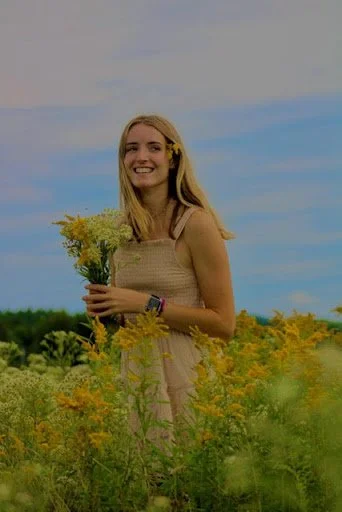
Ida Eames attended OVWS through 8th grade and graduated last year from Craftsbury Academy. She is attending Northern Vermont University in Johnson VT , where she received a full tuition scholarship because she was salutatorian of her high school class. She plays soccer at NVU and is majoring in Holistic Health.

Help us give Sweet Clover Nursery a Forever Home at the Child's Garden
As many of you know we have been looking for a forever home for Sweet Clover Nursery. After many meetings and proposals, we have confidently landed on moving Sweet Clover Nursery to the Child’s Garden Campus and have the support and momentum to manifest this dream.
Dear Orchard Valley Community,
As many of you know we have been looking for a forever home for Sweet Clover Nursery. After many meetings and proposals, we have confidently landed on moving Sweet Clover Nursery to the Child’s Garden Campus and have the support and momentum to manifest this dream.
We have been working with an architect whose site plans and drawings have been submitted and approved by the town, we are officially on the project board with contractors to do the renovation work, and we are mobilizing a team of volunteers to clear out the basement and barn.
This is our chance to reinvent the Child's Garden for our birth to three program!
We are feeling the support from our school board and faculty along with many other beloved families and community members. We have laid the groundwork to move forward on this project and need your help!
We have established a GoFundMe page where you can read project plans, updates, and donate to this exciting project:
HELP US GIVE SWEET CLOVER NURSERY A FOREVER HOME at the CHILD’S GARDEN
We are sure that you have many questions and we’d love to have the opportunity to answer them. Please send them to sweetclovernursery@ovws.org.
Thank you so much for your support!
Jada Berg
Jung Kim
Nolwenn Renault
Madelief Becherer
Marianne Perchlik
Anna Couture
(The Sweet Clover Nursery relocation committee)
Remembrances at Orchard Valley
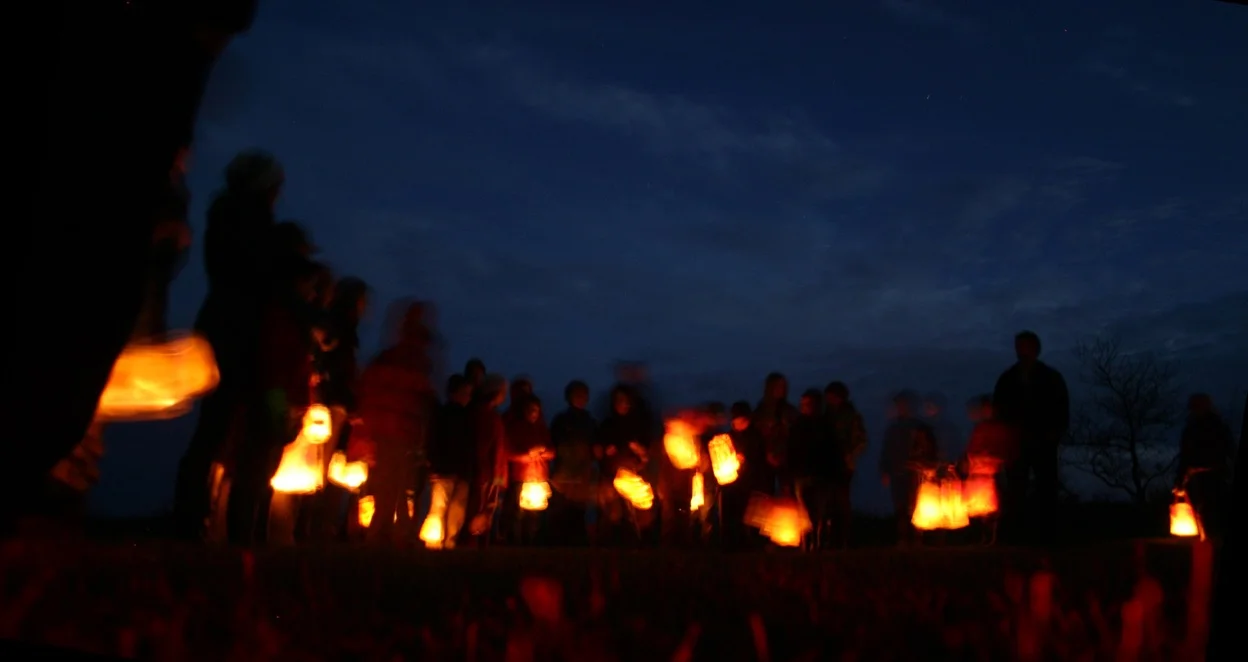
On November 2 we welcomed members of our community and beyond to remember those who have crossed the threshold between life and death.
Rudolf Steiner offered that death is perhaps the most significant stage of human development and provided glimpses of human life after death. Our embodied life on earth provides us the opportunity to spirited, moral action that lives on.
We remember some individuals from our Orchard Valley Community whose deeds in life created and nourished this learning environment.
On November 2 we welcomed members of our community and beyond to remember those who have crossed the threshold between life and death.
Rudolf Steiner offered that death is perhaps the most significant stage of human development and provided glimpses of human life after death. Our embodied life on earth provides us the opportunity to spirited, moral action that lives on.
We remember some individuals from our Orchard Valley Community whose deeds in life created and nourished this learning environment.
Jim Grundy was one of the first renewable energy leaders in the whole state of Vermont. He drove a big blue grease powered truck, long before anyone was fueling their vehicles with biodiesel. He created a business, “Elemental Energy,” and was the individual who installed our radiant floors and our solar panels. His work at Orchard Valley represents a strong environmental ethic that has always lived in our school. He is the “Star Daddy” of Ava and Esme in our 5 / 6 Grade.
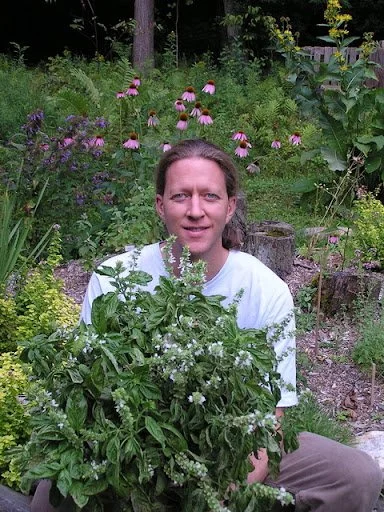
Tony French was a hydrologist who faithfully attended to the water testing and the quality of our drinking water at Orchard Valley. A dedicated member of the Grace Farm Committee, Tony helped organize pruning workshops and participated substantially in the tending of the apple trees. He is the father of two alums, Piper and Eli French and the spouse of Julie Henderson who served on the Board and provided dedicated support for many years to the birth of our school.

Kathy Clark served Orchard Valley from the first days. Administrative Assistant, Office Manager, Operations Manager are a few of the roles she served with dedication until the last day of her life. Kathy had run a home child care program as a mother, and she was specifically dedicated to the creation and development of the Sweet Clover Nursery. Her daughter Mary Kathryn (Molly) was in the first graduating class of our school and she continues sharing her gifts as a high school music teacher.


OVWS Celebrates the Formation of a Collegial Circle
The Orchard Valley Waldorf School would like to announce the formation of our Collegial Circle. The forming of a Collegial Circle, in addition to collaborative child focused decision making, acknowledges our growing consciousness that our endeavor in teaching the rising generation is a spiritual one. Our learning environment welcomes the whole human being: body, mind and soul. When we come together in collaboration we engage in the formation of spirited human activity, supported by unseen spiritual beings including the spiritual being of the Orchard Valley Waldorf School. Every person in our community contributes to the strength of our connection with the unseen force that is our school.
The Orchard Valley Waldorf School would like to announce the formation of our Collegial Circle. What, you may ask, is our Collegial Circle?
For over a year, beginning in the time of the school closure during the pandemic, our staff began seeking to understand the significance of forming “a College.” Waldorf Schools are intended to be governed collaboratively and by consensus, by teachers with the students at the heart of all decision making. Following our initial inquiries, the Board hired a Pedagogical Director to support us in understanding and developing a College. Last year, Lynn Rappaport supported our school in forming our Collegial Circle. We ended last year with a completed mandate welcoming staff members to consider joining after the completion of one year of employment at OVWS.
The forming of a Collegial Circle, in addition to collaborative child focused decision making, acknowledges our growing consciousness that our endeavor in teaching the rising generation is a spiritual one. Our learning environment welcomes the whole human being: body, mind and soul. When we come together in collaboration we engage in the formation of spirited human activity, supported by unseen spiritual beings including the spiritual being of the Orchard Valley Waldorf School. Every person in our community contributes to the strength of our connection with the unseen force that is our school.
Of primary importance to the Collegial Circle is caring and tending the delicate fabric of this relationship alongside our relationships with one another through which this being flows and becomes present. You are always warmly welcomed to contact any member of our Collegial Circle and in particular our Pedagogical Chair, with your questions or concerns.

On Tuesday October 18th at 4:15 pm , the Collegial Circle consecrated the formation of our Circle with a ceremony. Each member of the circle brought an offering of a song, a reading, and a stone. We lit a candle and shared the verse that has become associated with the College, offered by Rudolf Steiner for the first College of teachers. Teachers and mentors near and far joined us in spirit for the reading of this verse:
We wish to form our thoughts in such a way that we may be conscious that: Behind each of us stands their angel, gently laying their hands on the heads of each. This Angel gives you the strength which you need. Above your heads there sweep the circling Archangels. They carry from one to the other what each has to give the other. They unite your souls. Thereby you are given the courage of which you stand in need. Out of this courage the Archangels form a chalice. The light of wisdom is given to us by the exalted beings of the Archai, who are not limited to the circling movements, but who, coming forth from primal beginnings, manifest themselves and disappear into primal distances. They reveal themselves only in the form of a drop of light in this place. Into the chalice of courage there falls a drop of light, enlightening our times, bestowed by the ruling Spirit of our Age.
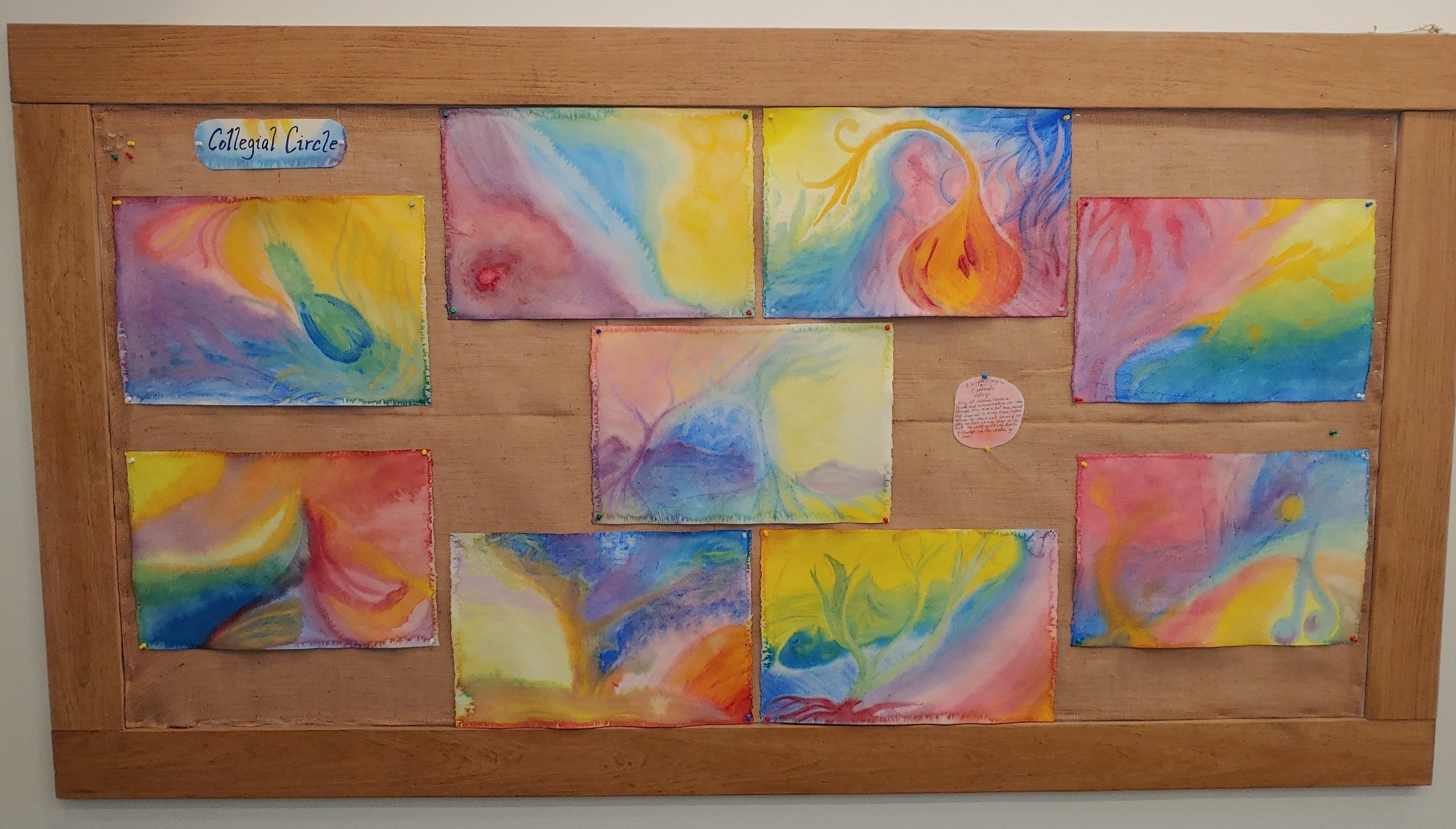
Following the offerings, we participated in a group painting process where all members of the group shared in contributing to nine paintings which are on display in the hallway of the Grades building. We closed the ceremony with a sound meditation using chimes and lyres in the Apple Tree Classroom. We created a book of verses gathered by members of the Collegial Circle. Collegial Circle members parted in the glory of an amazing autumn sunset over the beautiful lands of Orchard Valley.
Collaborative leadership is part of an evolutionary step forward that is still forming. We must now learn to work together more closely and effectively as companions holding shared responsibility and accountability for the work of education for the rising generation. We welcome your interest and engagement in this exciting new milestone in the development of our school.
With gratitude for the contribution of each person in our community in coming to this important moment for our school’s development,
Hannah Kraskow
Nolwenn Renault
Jada Berg
Michelle Gullage
Christa Young
Lottie Maker
Meg Scherbatskoy
Madelief Becherer
Marianne Perchlik

Alan LePage Grows Beautiful Vegetables at Grace Farm
A 7th generation Vermont farmer of the local LePage family, Alan evolved farming methods on his family land in Barre, VT towards biodynamic and organic practices to serve the Central Vermont community for over 30 years. Alan and a few others laid the foundation of the Montpelier Farmers’ Market from the ground up.
Now he shares his passion and dedication with Grace Farm, growing a productive vegetable and melon garden, hand-remediating soil health, and preparing beds for some 400 heads of garlic to be planted this fall.
A 7th generation Vermont farmer of the local LePage family, Alan evolved the farming methods on the family land in Barre, VT towards biodynamic and organic practices to serve the Central Vermont community for over 30 years. His daughter, Lila, recently took on Alan’s role as market farmer there.
Alan and a few others laid the foundation of the Montpelier Farmers’ Market from the ground up. His passion and dedication, not only to growing interesting organic vegetables, but toward remediating the earth and offering his expertise to the community of our school and the greater community interested in improving their gardening skills and stewardship skills is burgeoning.

In Alan’s transition from running his own market farm to contributing as an expert in the community, he is growing the following at Grace farm: A most productive vegetable and melon garden, hand-remediated soil health, bed preparation for some 400 heads of garlic to be planted this fall, as well as visions of integrating more botanical functional beauty and sustainable practices into the fabric of the Grace Farm landscape.
“This is incredibly rich and productive soil, or I wouldn’t be here.”
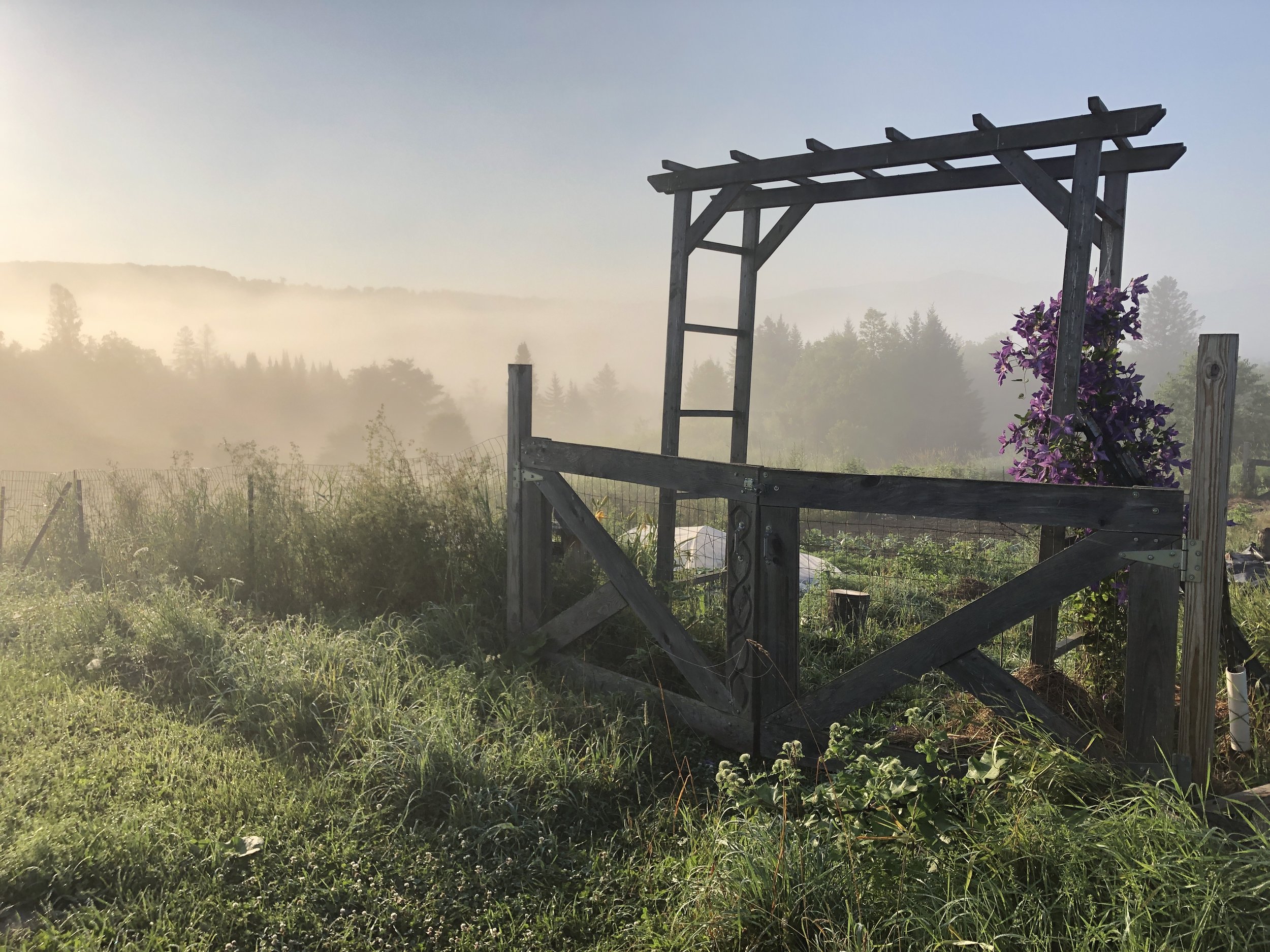
I invite you to take a moment to peek over the garden gate beside the climbing clematis to witness the bounty of having a local expert and elder who is committed to growing health and beauty through the soil (from the north lot at Grace Farm, walk past the garden shed and stone circle up the hill towards the garden gate).
Alan primarily tends the soil and garden, and secondarily, he educates. This fall, he will offer a Kimchi making workshop, from the garden to the ferment, on October 9th at Grace Farm. It is a measure of great abundance that Alan is here working with the land at Grace Farm.
Alan tends the foundation for a healthy organic and biodynamic garden this growing season with occasional help from a farming mentee, Devon Smolca. Their work is deep and effective, the potential is vast.
“Over the long term, I believe that the cultural requirements of agriculture are being unmet. Institutions (Cornell…UVM) teach agronomics, but they don’t teach the essence of agriculture to people who might be wanting to grow their own food and security for themselves and their neighbors, and gain the satisfaction of something that is life sustaining and fascinating - IF you can slow down enough to do this!”
Alan’s vision for enriched soil, farm sustainability methods and community impact is worth listening to. I recorded a conversation Alan and I had earlier this summer. Shuffle about halfway through to listen as Alan begins to hold court with his views on the importance of beauty and purpose.
His is a parallel expression of the pedagogy of Waldorf Education, through a vision for the earth, her bounty, and the impact on humans who engage in the physical and mental labor of tending her.
This is not surprising, as the mystic Rudolf Steiner envisioned both Waldorf Schooling and Biodynamic Gardening from the same basic value system of investing in the nourishment of ourselves, our children and the world.

With his radical and progressive views, Alan circles back to the old ways, and as a listener, I am reminded that the word radical stems from the latin ‘radicula’: the rootlet or part of the embryo of the plant which develops into the primary root. This work of the Waldorf educator, the organic gardener, the parent, child and human being who maintains a value on presence, beauty, and a reverent regard for human (child) development IS a contemporary radical notion.
We look forward to integrating the children and greater community into planting garlic this fall during our Community Michaelmas festival, and establishing a series of agricultural workshops led by Alan for the greater community, starting with the Kimchi Workshop on October 9th.
Alan LePage, an organic original, hosts practical advice, botanical history and esoteria, agronomics and radical fun on “The Curse of the Golden Turnip” Radio Show. WGDR 91.1 Plainfield, Sunday mornings 7-9 a.m.)
Story by Angie Barger

Lazure Workshop with Charles Andrade
This summer the Grades Building and the cubby room of the Farmhouse on the Grace Farm campus were transformed by a group of OVWS parents, grandparents, alumni parents, and teachers who gathered together to learn the art of Lazure from master Lazurist Charles Andrade.
This summer the Grades Building and the cubby room of the Farmhouse on the Grace Farm campus were transformed by a group of OVWS parents, grandparents, alumni parents, and teachers who gathered together to learn the art of Lazure from master Lazurist Charles Andrade.
Lazure is a color technique created by Rudolf Steiner and used in Waldorf schools all over the world. Steiner said that “children need to be surrounded by fluid living color.” The interplay between dark and light in Lazure painting helps to create depth, breathability, and a harmonious soul experience. What more could we want for the space in which our children learn and spend the majority of their day?
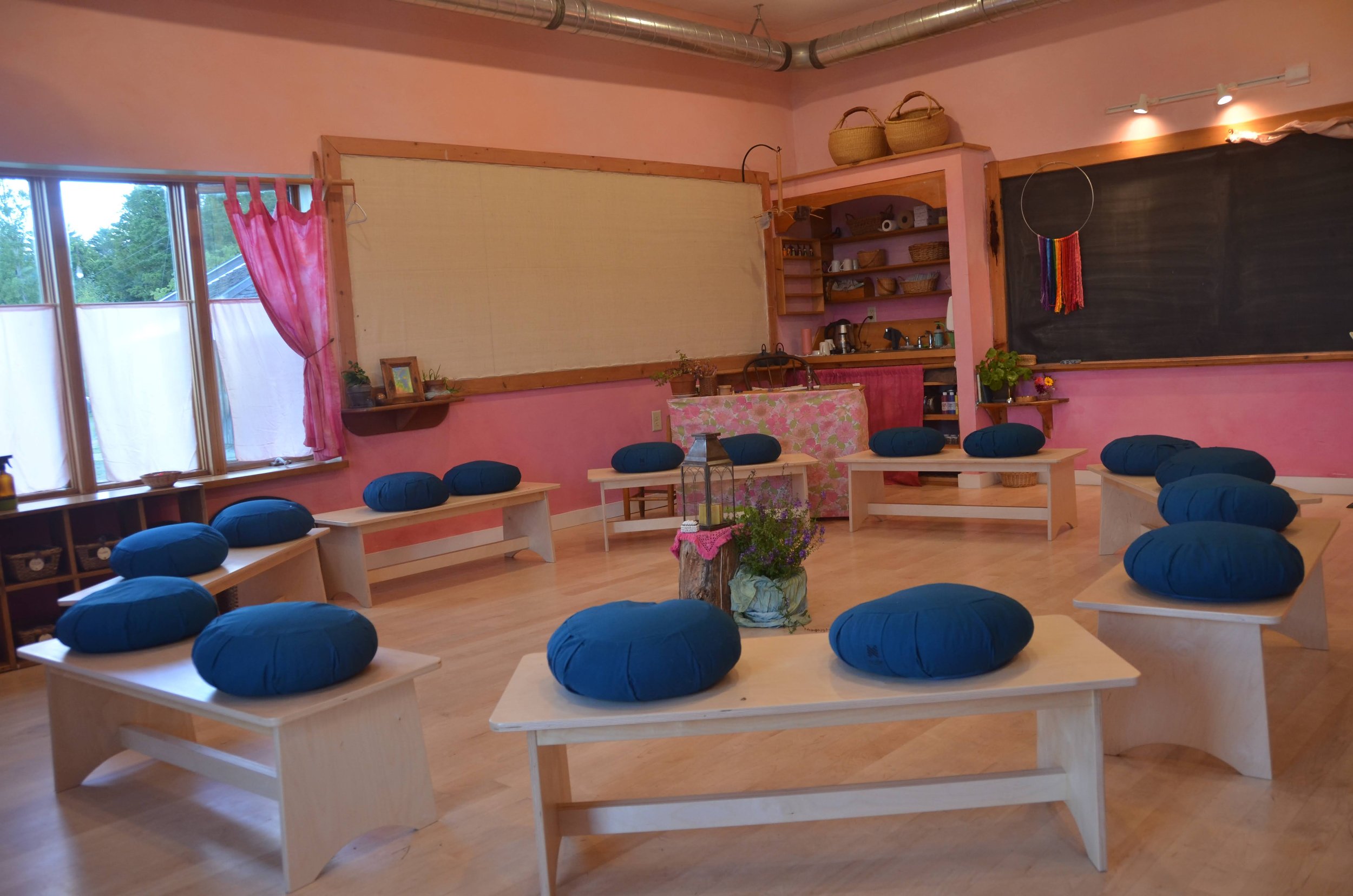
The colors for each classroom are chosen based on the development of the child. The rosy, warmer tones stimulate the will forces in the kindergarten and early grades. Moving from reds in first grade, through orange in second, and yellow in third; the cooler tones arrive with a luminous green in fourth grade that mirrors the nourishing green of the heart chakra and the feeling realm. The middle school years cool down with turquoise, blues, and violets, appealing more to the developing forces of clear thinking.
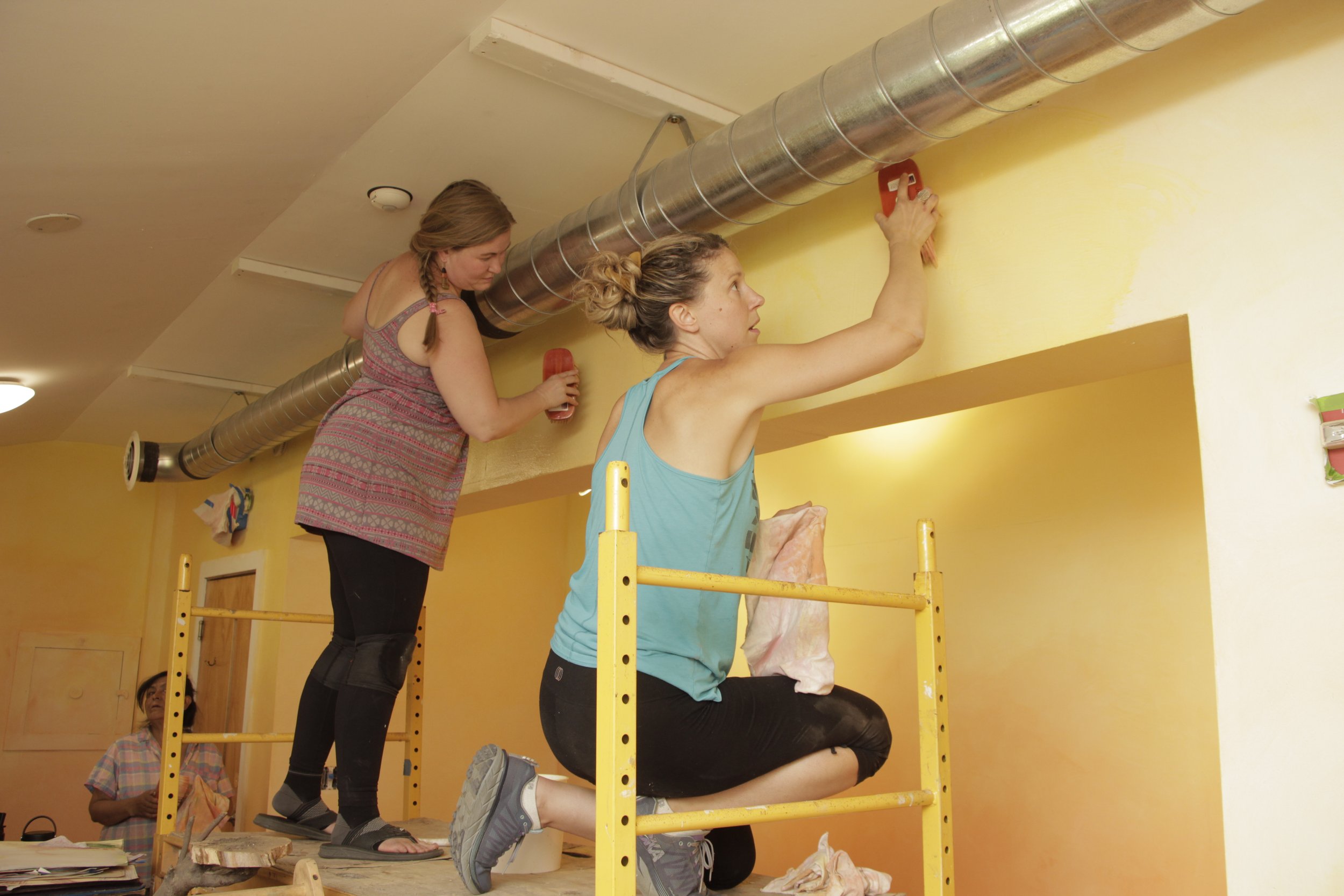
The Lazure workshop was a stimulating and nourishing experience for those lucky enough to partake. It included an introductory lecture and two intense days of hard work, followed by additional hours painting the classrooms and Front Office, and prepping the Grades hallway for future Lazure treatment.

As a social art form, the participants had to work together collaboratively to create the harmonious flow of color. As is articulated on Andrade’s website, “The benefits of such workshops go beyond the instruction of the group and into the community they share.”
If you haven’t yet seen the results, please take a peek into the Grades classrooms, and if you’d like to volunteer to help with future Lazure work, please reach out!
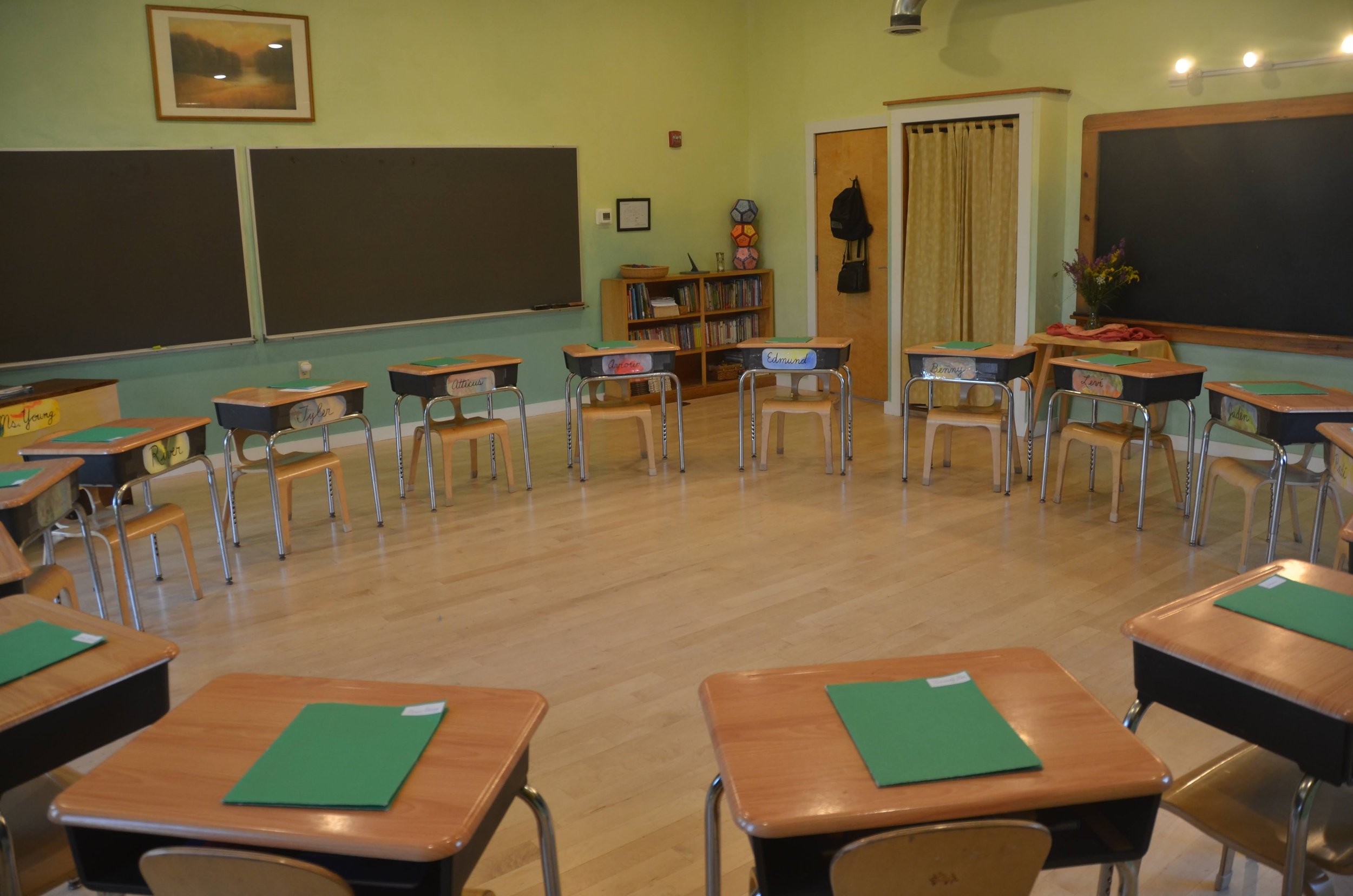
The colors and their movement across the walls are at once breathtaking and calming. As Charles Andrade says, “The role of the arts [in a Waldorf school] is to develop a relationship between . . . human souls and the world of sensory phenomena.” Enveloping the children in Lazured spaces bathes them in this experience.
by Victoria Mansuri
for the Aesthetics Committee